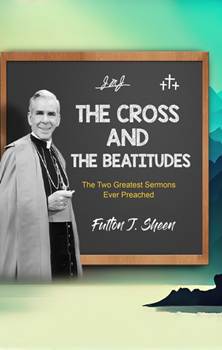
Over the years, I have had the joy of republishing many of Fulton J. Sheen’s books. One day, while working on his 1937 classic, The Cross and the Beatitudes, I was asked by the editorial staff to come up with a creative subtitle for the book. After reading through Fulton Sheen’s analysis of how the Sermon on the Mount (The Beatitudes) is connected to the Sermon on Mount Calvary (The Seven Last Words), I came up with the subtitle, The Two Greatest Sermons Ever Preached.
Now that subtitle wasn’t simply clever marketing. The longer I spent reading Sheen’s manuscript, the more convinced I became that he had uncovered something many Christians overlook. The first sermon Christ gave on the Mount, and the last sermon He gave on Mount Calvary are not two unrelated events. They belong together. On the mountain, Christ teaches the Beatitudes. On Calvary, He lives them.
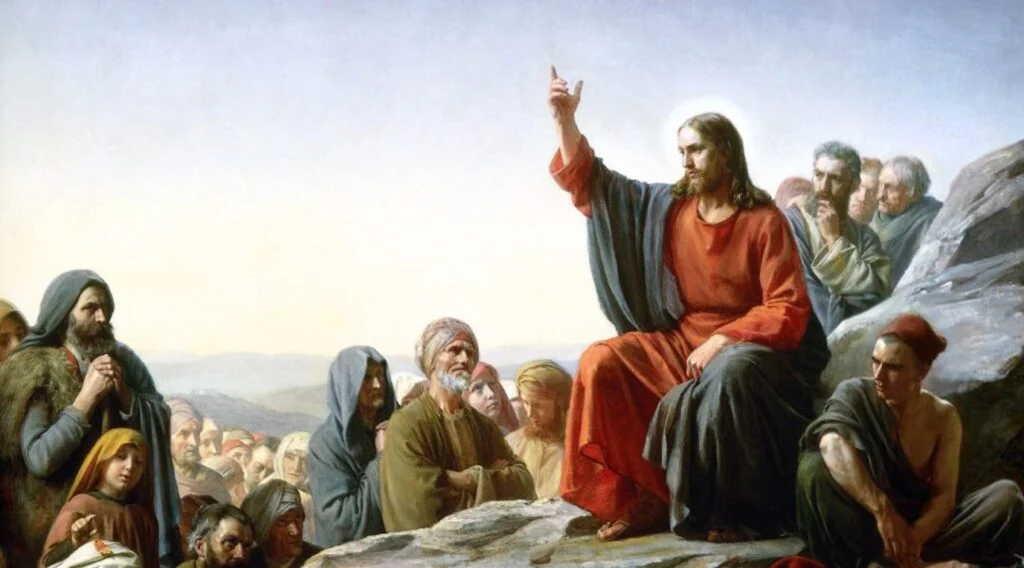
The Beatitudes (Matthew 5:1-12)
Seeing the crowds, he went up on the mountain, and when he sat down his disciples came to him. And he opened his mouth and taught them, saying:
Blessed are the poor in spirit, for theirs is the kingdom of heaven.
Blessed are those who mourn, for they shall be comforted.
Blessed are the meek, for they shall inherit the earth.
Blessed are those who hunger and thirst for righteousness, for they shall be satisfied.
Blessed are the merciful, for they shall obtain mercy.
Blessed are the pure in heart, for they shall see God.
Blessed are the peacemakers, for they shall be called sons of God.
Blessed are those who are persecuted for righteousness’ sake, for theirs is the kingdom of heaven.
Blessed are you when men revile you and persecute you and utter all kinds of evil against you falsely on my account.
Rejoice and be glad, for your reward is great in heaven, for so men persecuted the prophets who were before you.
The Interior Shape of a Blessed Life
When Jesus proclaimed the Beatitudes, I believe that He was not offering a list of ideals meant to inspire admiration from a distance. He was describing a way of life meant to be lived—a pattern of the heart shaped by grace and tested by the Cross.
Archbishop Fulton J. Sheen often reminded his listeners that the Beatitudes are not sentimental promises or spiritual slogans. They are paradoxes. They overturn the world’s understanding of success, strength, and happiness. In a culture that equates blessing with comfort and power, Christ calls the poor, the meek, the merciful, and the persecuted blessed. These words do not flatter the ego; they convert it.
He also invited us to receive the Beatitudes not as moral demands imposed from outside, but as the interior fruit of a life united to Christ. He stated that “the Beatitudes are not eight separate virtues to be mastered one by one, but a single vision of holiness: a portrait of Christ Himself.” In truth, Jesus did not merely preach the Beatitudes; He lived them. And they reached their fullest expression on the Cross.
Sheen taught that the Sermon on the Mount finds its fulfillment on Calvary. What Christ proclaimed with His lips, He sealed with His life. Poverty of spirit, meekness, mercy, purity of heart, endurance under persecution—all are revealed most clearly in the suffering love of Christ crucified. The Beatitudes are not detached from suffering but transfigured by it.
The Interior Disposition Needed to Live the Beatitudes
Last year, I was asked to lead a retreat on the Beatitudes. In my opening conference, I encouraged the retreatants not to measure themselves against perfection. The Beatitudes are not spiritual scorecards. They are windows, and through them Christ allows us to see what He is quietly forming within our hearts. I encouraged everyone not to approach the Beatitudes as a list of impossible ideals, but as an invitation to discover the interior dispositions Christ desires to form within them.
Throughout the retreat, I reminded the group that the Beatitudes are not merely sayings to admire. They are dispositions to be formed. When Christ proclaimed them on the mount, He was revealing the very shape of a heart transformed by grace. As you contemplate each Beatitude, try not to ask, How well am I doing? Instead, ask, Lord, what are You trying to form within me?
As our retreat continued, I invited the participants to reflect on questions such as these:
- Where do I resist dependence upon God?
- Where do I avoid sorrow rather than bringing it to Christ?
- Where do I cling to control instead of surrender?
- Where does resentment still linger in my heart?
- Where is my love divided?
These questions are not meant to condemn or accuse. They are invitations to grace, as the Beatitudes reveal not where you have failed, but where Christ desires to continue His work within you. Be patient with yourself. Transformation is seldom dramatic. More often, it happens quietly, one act of surrender at a time.
Christ, the Living Beatitudes
On the Cross, Christ is poor in spirit, stripped of everything and trusting the Father alone. He is meek, restraining power that could destroy His enemies. He mourns, bearing the sorrow of a fallen world. He shows mercy, forgiving those who crucify Him. He is pure of heart, loving without division. He makes peace, reconciling humanity to God. He is persecuted for righteousness’ sake and remains faithful unto death.
Seen in this light, the Beatitudes are not separate virtues to be achieved one by one. They are a single portrait of Christ. To live the Beatitudes is not to imitate a list, but to conform one’s life to Him. The closer the disciple draws to Christ, the more these dispositions take shape within the heart.
Fulton Sheen often reminded us that Christianity is not the imitation of Christ from a distance, but participation in His life. The Beatitudes describe what happens when Christ lives within the soul. They unfold not through moral strain, but through surrender to love shaped by the Cross.
The Blessed Life in an Unblessed World
The Beatitudes do not describe the world as it is. Rather, they reveal a life as God intends it to be lived within a broken world. Christ never promised that the blessed life would be easy, admired, or widely understood. He promised that it would be true.
Archbishop Fulton J. Sheen often observed that the Christian is called not to escape the world, but to live differently within it. The Beatitudes are not ideals reserved for saints in stained glass. They are meant to be lived in homes, workplaces, friendships, and in our daily struggles—quietly, faithfully, and often without recognition.
To live the Beatitudes today is to accept a certain tension. The poor in spirit will appear impractical. The meek will be misunderstood. Those who hunger for righteousness will seem restless. The merciful will risk being wounded again. The pure of heart will resist illusion.
Peacemakers will refuse easy compromise. Those who mourn will carry sorrow honestly. The faithful will endure opposition without bitterness. Yet Christ calls this life blessed!
Sheen reminds us that happiness cannot be secured by rearranging circumstances. The orientation of the soul forms it. The Beatitudes shape that orientation. They form a heart anchored in God rather than in success, approval, or comfort. Such a heart is not immune to suffering, but it is free.
Let us ask ourselves: how do the Beatitudes take flesh in our own daily life? Where are we being asked to live differently? Where does Christ’s vision challenge our assumptions about happiness? The blessed life is not lived all at once. It is lived through countless small choices that align the heart with truth.
The Beatitudes will continue their work within us as we live them imperfectly, patiently, and honestly. Christ blesses those who let Him reshape the heart—even when the world does not understand.
Perhaps that is why Archbishop Sheen called our attention to these two mountains. One teaches us what a disciple is meant to become. The other shows us how Christ makes that transformation possible.
Editor’s Note: This article is a part of a CE original series, “Cultivating the Soul of a Disciple with Blessed Fulton Sheen,” in celebration of and preparation for Archbishop Sheen’s beatification this September.
Author’s Note: If you enjoyed this reflection, you may wish to continue exploring Archbishop Fulton J. Sheen’s insights on the Beatitudes. His classic work, The Cross and the Beatitudes, is included in my anthology, The Cries of Jesus from the Cross, in which Fulton Sheen beautifully demonstrates how the Sermon on the Mount finds its fulfillment in Christ’s saving sacrifice on Calvary.
Readers wishing to continue this journey will also find a guided retreat on the Beatitudes in my latest book, The Soul of a Disciple: Fulton Sheen’s Meditations on the Cross, the Eucharist, and the Christian Life (Sophia Institute Press). Drawing upon Sheen’s timeless wisdom, the retreat invites readers to pray with the Beatitudes and discover how Christ gradually forms His own life within every disciple.
Image from Wikimedia Commons
Source: Catholic Exchange — View original publication