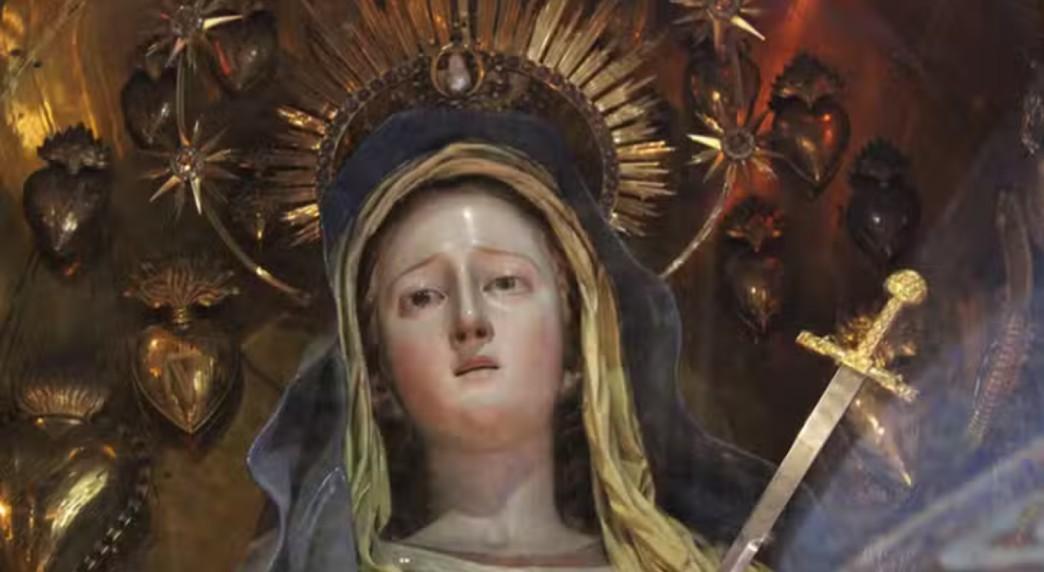
Image: Our Lady of Sorrows statue in Golgotha, Holy Sepulchre Jerusalem | photo by creisor
Saint of the Day for September 15
Our Lady of Sorrows
The Story of Our Lady of Sorrows
For a while there were two feasts in honor of the Sorrowful Mother: one going back to the 15th century, the other to the 17th century. For a while both were celebrated by the universal Church: one on the Friday before Palm Sunday, the other in September.
The principal biblical references to Mary’s sorrows are in Luke 2:35 and John 19:26-27. The Lucan passage is Simeon’s prediction about a sword piercing Mary’s soul; the Johannine passage relates Jesus’ words from the cross to Mary and to the beloved disciple.
Many early Church writers interpret the sword as Mary’s sorrows, especially as she saw Jesus die on the cross. Thus, the two passages are brought together as prediction and fulfillment.
Saint Ambrose in particular sees Mary as a sorrowful yet powerful figure at the cross. Mary stood fearlessly at the cross while others fled. Mary looked on her Son’s wounds with pity, but saw in them the salvation of the world. As Jesus hung on the cross, Mary did not fear to be killed, but offered herself to her persecutors.
Reflection
John’s account of Jesus’ death is highly symbolic. When Jesus gives the beloved disciple to Mary, we are invited to appreciate Mary’s role in the Church: She symbolizes the Church; the beloved disciple represents all believers. As Mary mothered Jesus, she is now mother to all his followers.
Furthermore, as Jesus died, he handed over his Spirit. Mary and the Spirit cooperate in begetting new children of God—almost an echo of Luke’s account of Jesus’ conception. Christians can trust that they will continue to experience the caring presence of Mary and Jesus’ Spirit throughout their lives and throughout history.
Our Lady of Sorro
Source: Saints and Feast Days — View original publication